
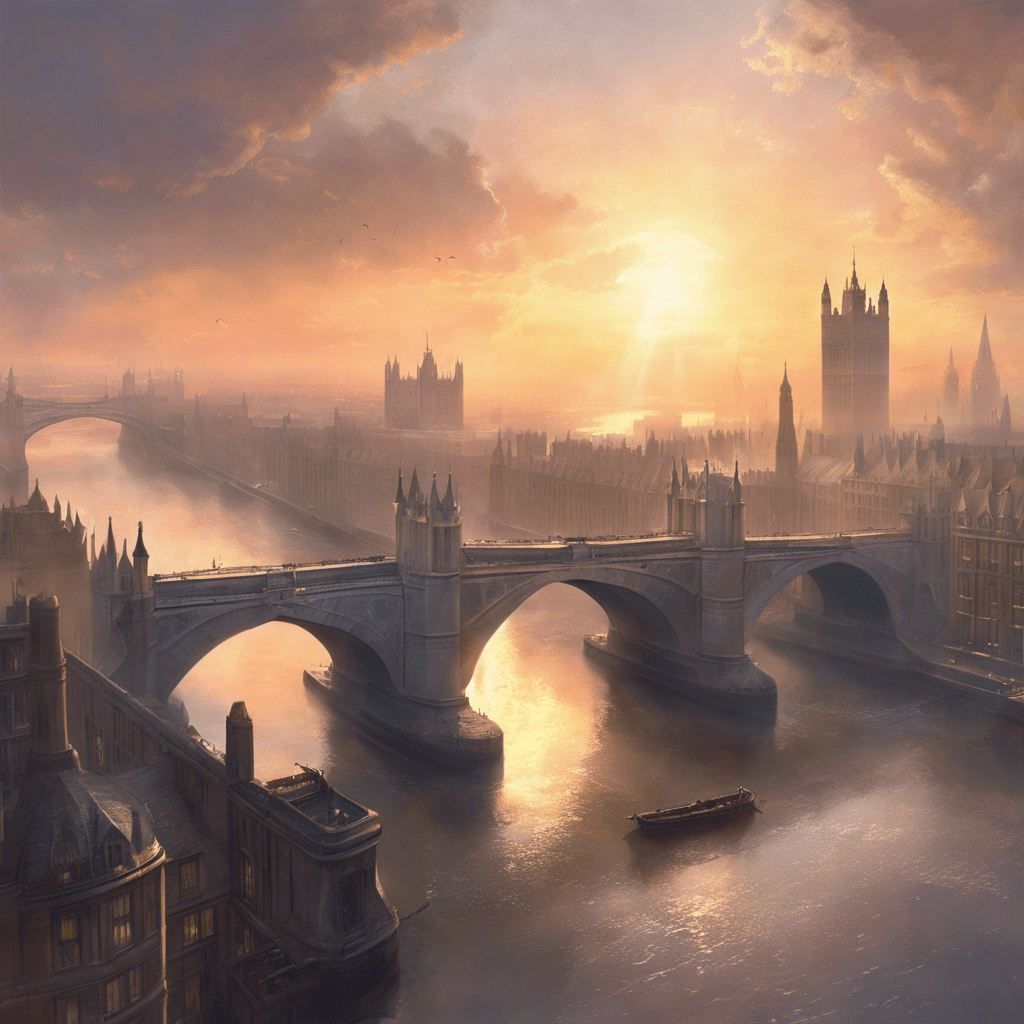
Bridge, September 3, 1802 – William Wordsworth
Earth has not anything to show more fair:
Dull would he be of soul who could pass by
A sight so touching in its majesty:
This City now doth, like a garment, wear
The beauty of the morning; silent, bare,
Ships, towers, domes, theatres, and temples lie
Open unto the fields, and to the sky;
All bright and glittering in the smokeless air.
Never did sun more beautifully steep
In his first splendour, valley, rock, or hill;
Ne’er saw I, never felt, a calm so deep!
The river glideth at his own sweet will:
Dear God! the very houses seem asleep;
And all that mighty heart is lying still!
Summary
The persona crosses Westminster Bridge and sees the beauty of the early morning. He has never done this before and is amazed by the small details of nature, and he becomes overwhelmed by the tranquility and beauty of nature. Wordsworth uses the title to mark a precise place and time which is the view that overlooks London’s River Thames during the Industrial Revolution. This is common in many of the poet’s works as he looks at the power and fleeting nature of moments that he remembers. The speaker looks at the city at dawn and sees it for its stunning beauty. He also acknowledges the industrial forces that transform nature.
The poet presents London as a transparent, soft light of dawn and before it is interrupted by human actions. The many different buildings in the city stretch outward and upward, until they merge into the surrounding farmland and overarching sky. The city is stunning and shines like a diamond. The air is clear. He marvels at the beauty of the sunlight which has never shone on any feature of the natural landscape more beautifully than it now shines on the city. He has never seen nor felt such pure and steady peacefulness. The river flows easily, guided only by the forces of nature.
Theme – Nature versus Civilization
The speaker reflects on the pre-dawn view of London from a bridge. The speaker observes the city and its natural surroundings in the clear, quiet dawn. He sees them as separate and unified. By comparing the city to the natural world around it, the poet stresses the problem of locating a clear boundary between the two. The poet notes that the city is an extension of nature.
The title hints at the bridge which acts as a symbol of the bond between the human and the natural world. The bridge is a man-made construct that spans the river Thames. But it provides a barrier between people and the water. It also allows people to view the water from a distance. The bridge also represents the connection between nature and overcoming nature. The persona notes that the city is the best-looking attribute on Earth. He notes that the sight of it is “touching.”
The speaker challenges the borders between nature and the city. He lists the manmade structures “Ships, towers, domes, theatres, and temples,” that points to the difference between urban and natural scenery. But with all the differences, he realizes that all these man-made structures are connected to nature. They lie “Open unto the fields,” as they accept their debt, “and to the sky,” as if to locate both the city’s aspirations and its limits. Furthermore, the city’s openness suggests a fluid border—that there is no clear line where the city ends, and nature begins. He continues with the river glides through the city “at his own sweet will.”
The persona looks at the combination of the city and nature. He realizes that the city is ideal when the sun comes up and that the morning sunlight is even more magnificent when it hits the city: “Never did sun more beautifully steep / In his first splendour, valley, rock, or hill”. In other words, the sunlight increases the fairness of the city that seems to glitter with more majesty than “valley, rock, or hill” ever did. The buildings are also “silent” and “bare” as mountains which make them peaceful.
Theme Individuality vs. Community
In describing London, the speaker refers to a variety of human experiences. The poem addresses the tension between the speaker and the city as he or she observes the new dawn and questions the concept of the city’s identity. The speaker wants to know if the city holds an identity or is it just a bunch of disparate pieces lying closely together. The use of the first person and personifying different aspects of the city allows the reader to see the city as a unified whole. There is reference to the size of the city as well as the diversity and the unique and cohesive identity. The speaker takes a single spot in a single time and uses the title of the poem “Composed upon Westminster Bridge, September 3, 1802” to narrow the views of the city and nature.
The first three lines of the poem emphasize the tension between the individual and the city. They give the poet’s view about the beauty of the city as dawn comes. Lines 1 and 2 confirm that a single city-dweller (or city-visitor) is speaking. But the third line changes the tone and widens the scope. The reader sees that the poem is about the wider, thoughtful “majesty” of the city. This is presented from an individual perspective and speaks to the whole of London. He speaks with such certainty, and this suggests that the sight of the city can be emotionally stirring for anyone.
The speaker sees the city for its likeness to a person who wears the “beauty of the morning” “like a garment.” Here, the speaker gives a contrast between the city and its many unique inhabitants. He further reminds the readers that the city would not exist if it were not for living, breathing human beings. The speaker finishes with a striking image that characterizes the city-dweller and the city. He notes: “the very houses seem asleep; / And all that mighty heart is lying still!” The speaker shifts from using the plural “houses” to the single metaphoric reference to the “heart.” This also alludes to the many individual people who function as a single unit in the city. The poet ends with the reference to the “mightiness” of this solitary heart. This alludes to strength which offers a unified identity of the city.
Fleeting Beauty
The poem takes place at dawn. There is a moment of fleeting peacefulness before the city wakes up. The poet enjoys this moment because he knows that soon the city will awaken and disturb his calm. This temporariness is common throughout the poem. The reader understands that this is important as the city represents change which transformed the landscape and reordered human life. Hence, the poet alludes to fact that while beauty and tranquility are not permanent, it can be recovered.
In the opening lines, the poet talks about a version of the city that is only fleeting. It is “touching” and fair in its glory while it is “silent” and “bare.” The speaker does not say what will come after. Yet, history shows that during the Industrial Revolution, London experienced the noise and roughness which replaces the silence and fairness when the city awakens. Hence, the reader knows that the beauty and tranquility of the early morning will not last. The speaker is moving and is not just standing on the bridge and therefore he observes from a broader perspective.
The poet only hints at the features of an industrial city and emphasizes the temporary nature of what he is seeing. He further describes the buildings as “All bright and glittering in the smokeless air.” This aids in highlighting the setting. There is also clarity in the literal meanings of the words: “glittering” and “bright.” But, this clear atmosphere only exists because there is no smoke in the air. But this will only happen if the factories are closed.
The “river glideth” and there is nothing to divert or block it in a busy city. This means that the river runs “at his own sweet will,” and without human obstruction. This tranquil image adds to the speaker’s deep calm but could also imply that the river was growing more polluted each day because of the factories and slaughterhouses along the river.
The language that the speaker uses in Stanza Two is even more exciting because there is constant change in the morning, there is still beauty in the city. The enthusiasm of the speaker does not waver as he appears to be seeing this beauty for the first time. He also understands that this can change quickly. Still, the fleeting beauty of dawn is more rewarding because it is temporary.
Tone
Reverent
Celebratory of the beauty of nature
Mood
Amazement,
Serenity or wonder.
Analysis
“Earth has not anything to show more fair:”
The persona uses this hyperbole to create visual imagery that speaks to the ‘fair’ sight before him. He thinks that this must be the greatest that the world has to offer simply because of how he feels as he observes its beauty.
“Dull would he be of soul who could pass by a sight so touching in its majesty:”
The persona notes that anyone who would simply walk past the beautiful sight would be “dull… of soul.” The use of the word ‘majesty’ in this line alludes to the regal beauty of the early morning.
“This City now doth, like a garment, wear the beauty of the morning; silent, bare,”
The persona uses a simile to describe the city and the way that it wears the morning’s beauty like a garment. This comparison is like a piece of clothing sliding smoothly over the body of a person. Therefore, the beauty of the morning “settles” over the city perfectly. The silence and emptiness of the morning is attributed to the city, which reveals the start of a new day.
“Ships, towers, domes, theatres, and temples lie open unto the fields, and to the sky; all bright and glittering in the smokeless air.”
The structures of the city are manmade which makes them different from the natural elements and yet they appear just as beautiful and sublime with the glory of the morning air. Everything is beautiful. The persona also alludes to the clear air because the factories and vehicles have not begun to spit smoke into the air yet.
“Never did sun more beautifully steep in his first splendour, valley, rock, or hill; “
The persona uses hyperbole once more as he adores nature. He states that the sun has never looked this beautiful, as the sun enhances the beauty of the valleys and hills. He uses the word ‘steep,’ which usually describes how a teabag is left to soak in boiling water when making tea. In this line, the persona describes the sun at sunrise, and how it appears to soak slightly under the horizon like a teabag.
“Ne’er saw I, never felt, a calm so deep!”
The persona’s admiration gets even higher when he sees the allure of the world around him. It is overwhelming and he uses hyperbole to show that he has never felt such a deep calm before.
“The river glideth at his own sweet will”
The poet uses personification to describe the serenity and calm of the flow of the river which is usually disturbed by boats and vessels. But he notes that the river is now free to glide at his own leisurely pace.
“Dear God! the very houses seem asleep;”
The persona is overwhelmed by what he sees. He acknowledges the presence of God in such a serene scene. Even the houses, who he personifies to say they are sleeping, seem at peace- quiet.
“And all that mighty heart is lying still!”
This line of the poem likely refers to the heart of the city with its constant rhythm and movement that would happen later in the day. This is absent in the early morning because the place is still, restful, and silent.
Figurative Devices
Personification
Line 12- “The river glideth at his own sweet will”
The poet personifies the river to describe how it seems so casual and tranquil in its slow flow. The river, usually disturbed by boats and vessels, is now free to glide at its own leisurely pace.
Line 13- “Dear God! the very houses seem asleep;”
The poet shows that the houses are sleeping or that they seem to be at peace because no one is moving inside.
Simile
Lines 4-5-“”This City now doth, like a garment, wear the beauty of the morning; silent, bare,”
This simile suggests that the city wears the beauty of the morning like a garment. This gives the impression of a dress or similar item of clothing that settles smoothly over a person’s body. Therefore, the beauty of the morning settles over the city perfectly. The silence or an emptiness reflects the beginning of the new day.
Discover more from Think and Write for CSEC English A and B
Subscribe to get the latest posts sent to your email.

