
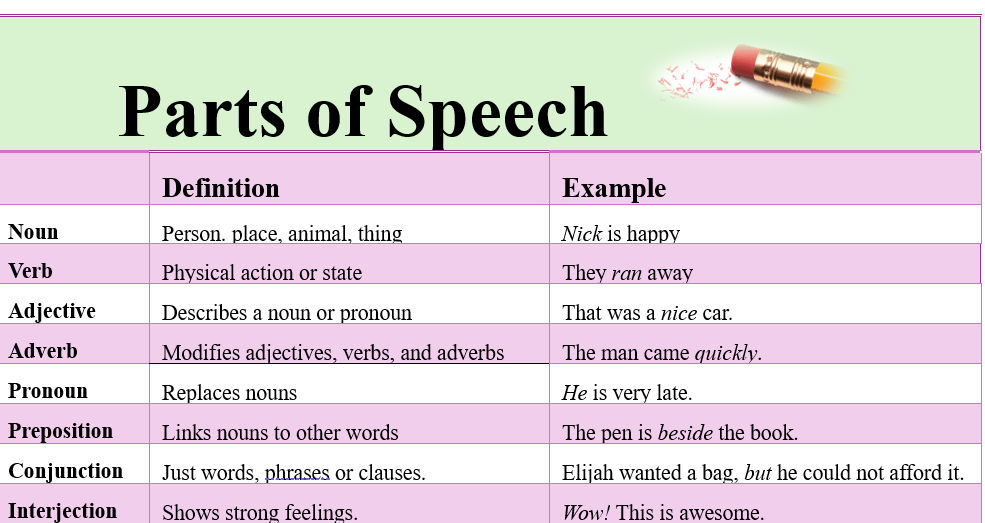
In the realm of language and communication, understanding the fundamental building blocks is essential. The 8 parts of speech serve as the foundation upon which our thoughts and ideas take shape. Whether we are crafting an essay, engaging in a conversation, or simply expressing ourselves, a solid grasp of these parts of speech empowers us to communicate effectively and efficiently.
Nouns
Nouns, the first part of speech, encompass people, places, things, or concepts. They provide the subjects and objects of sentences, lending specificity and clarity to our expressions. For instance, in the sentence:
“Emily walked to the park,”
“Emily” and “park” are both nouns.
Verbs
Verbs, on the other hand, bring action and movement to our sentences. They describe what the subject is doing or experiencing. In the sentence
“John eats an apple,”
“eats” is the verb, and it shows the action of John consuming the apple.
Adjectives
Adjectives modify or describe nouns and pronouns. This allows for additional details and characteristics of the nouns or pronouns. For example, in the phrase
“a beautiful sunset,”
the word “beautiful” is as an adjective, that enhances our understanding of the sunset.
Adverbs
Adverbs are like adjectives in that they describe or modify words. However, adverbs primarily modify verbs, adjectives, and other adverbs. They answer questions such as how, when, where, or to what extent. In the sentence
“She sings beautifully,”
the word “beautifully” is an adverb, describing how she sings.
Pronouns
Pronouns replace nouns and allow us to avoid repetition. They can refer to specific individuals or groups, representing them in a concise manner. In the sentence
“He is my brother,”
the word “he” is a pronoun. It replaces the noun that represents the speaker’s brother.
Prepositions
Prepositions show relationships between different elements in a sentence. They express location, time, or direction. In the phrase
“The book is on the table,”
the word “on” is a preposition, demonstrating the relationship between the book and the table.
Conjunctions
Conjunctions connect words, phrases, or clauses, allowing for smooth transitions and logical flow in our sentences. They can be coordinating, such as “and” or “but,” or subordinating, such as “because” or “although.” In the sentence
“I love ice cream, but I’m lactose intolerant,”
the word “but” is a conjunction, linking two contrasting ideas.
Interjections
Interjections are words or phrases that express strong emotions or sudden reactions. They add emphasis or convey the speaker’s feelings. “Wow!” or “Oh no!” are examples of interjections, adding a burst of emotion to our expressions.
By understanding and utilizing these 8 parts of speech, we can construct sentences that effectively communicate our thoughts and ideas. They provide the tools necessary for clear and concise expression, enabling us to connect with others and convey our messages with precision.
So, next time you write an essay, engage in a conversation, or craft a heartfelt letter, remember the power of the 8 parts of speech. Embrace their versatility, experiment with their usage, and unlock the full potential of your communication skills.
Keep learning, keep exploring, and keep communicating!
Discover more from Think and Write for CSEC English A and B
Subscribe to get the latest posts sent to your email.

